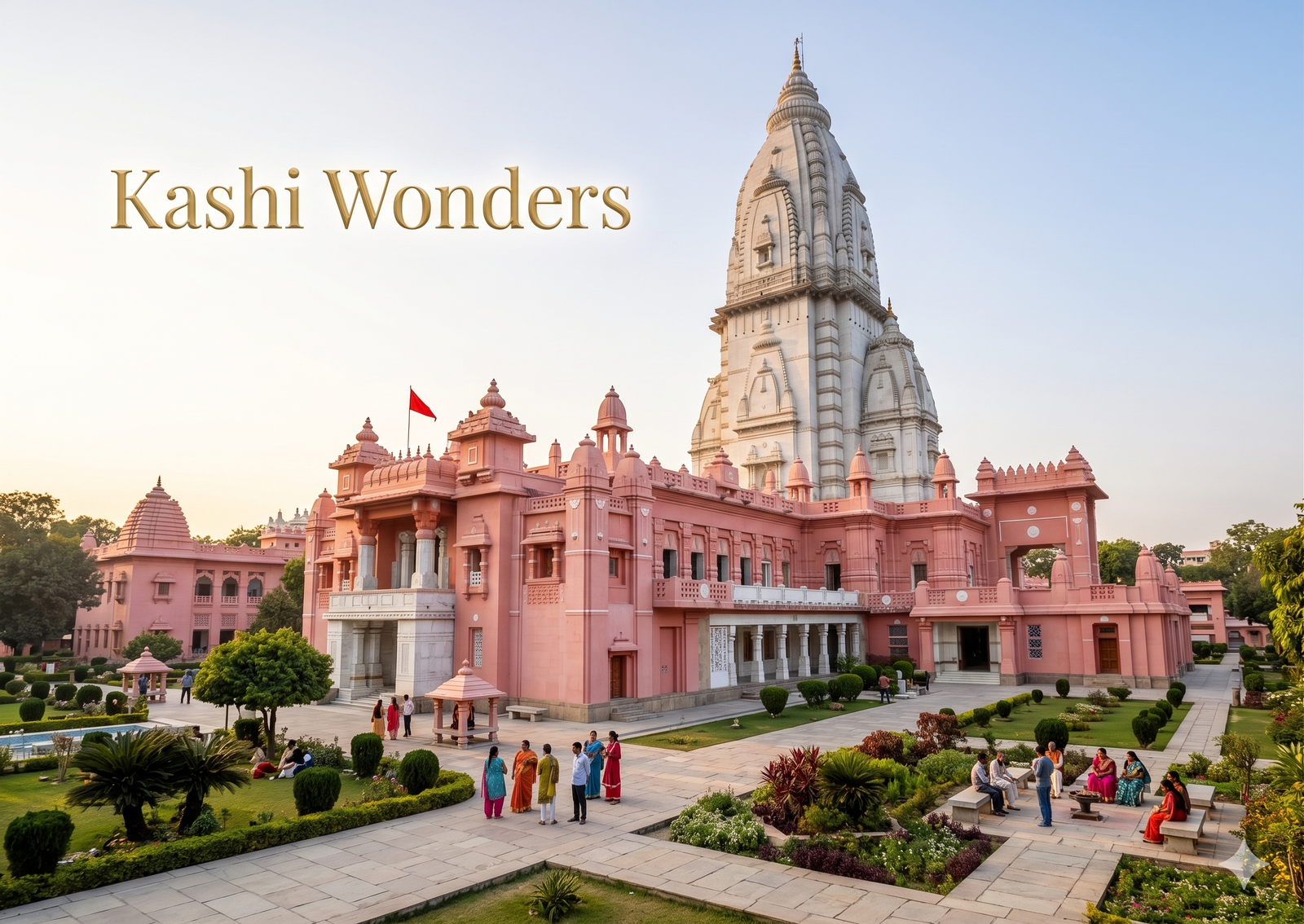
For those of us who live in Kashi, the New Vishwanath Temple (VT) is more than just a place of worship; it is the beating heart of the BHU campus. While the old city's Vishwanath Gali is a maze of chaos and devotion, the lanes of BHU are lined with sprawling Laburnum and Gulmohar trees, leading you to a temple that feels as grand as it is welcoming.
Built through the vision of Pandit Madan Mohan Malviya and the patronage of the Birla family, this temple was intended to be a center where people of all castes and creeds could worship together. It took 35 years to complete, and when you stand at its base looking up at the 250-foot Shikhara, you realize every year was worth it.
The Architecture of Inclusivity: A Marble Poem

Unlike many traditional temples in Varanasi where space is tight and the sky is blocked by narrow buildings, VT is expansive and sky-reaching. The design is a fusion of traditional Nagara style with modern structural integrity.
- The Tower (Shikhara): Reaching a height of 77 meters (250 feet), it is the tallest temple tower in the world. It was designed to be seen from across the university, acting as a spiritual lighthouse for students.
- The Narrative Walls: As you walk through the circumambulatory path (Pradakshina path), the walls speak to you. The entire Bhagavad Gita and excerpts from the Vedas are meticulously carved into the white marble. It wasn't just built to be looked at; it was built to be read.
- Multi-Level Sanctums: * Ground Floor: Dedicated to Lord Shiva, featuring a massive, serene Shiva Lingam made of black stone.
- First Floor: Houses the Lakshmi Narayan, Durga, and Ganesha temples. The spatial planning allows for thousands of devotees to move without the "dhakka" (shove) often felt in the old city.
- The Material: Using premium white marble sourced from Rajasthan, the temple reflects the sun in a way that it seems to glow during the afternoon, cooling down significantly by the time the evening breeze hits the campus.
History & Significance: Malviya’s Dream
The story of VT is inextricably linked to the founding of BHU itself. Pandit Madan Mohan Malviya envisioned a temple that would mirror the university’s soul—a place where tradition meets modern education.
- Foundation of Equality: At a time when temple entry was often restricted, Malviya Ji insisted that this temple be open to all, regardless of caste or religion. This was a radical spiritual statement in the early 20th century.
- The 35-Year Journey: Foundation stones were laid in 1931, but the intricate marble work and the sheer scale of the Shikhara meant the temple wasn't completed until 1966. The Birla family, specifically Jugal Kishore Birla, funded the project to ensure Malviya’s dream didn't compromise on quality.
- A Cultural Bridge: While the Kashi Vishwanath Temple in the city represents the ancient, indestructible spirit of Kashi, the Birla Temple represents its intellectual and progressive future. It serves as a reminder that Sanatana Dharma is as much about knowledge and inclusion as it is about ritual.
Why Locals Call it "VT"
In the student-led lingo of Banaras, the temple is affectionately called "VT." It’s the primary social and spiritual hub for thousands of students. If you visit in the evening, you’ll see scholars debating on the lawns, families sharing snacks, and the heavy scent of incense mixing with the smell of freshly fried Samosas from the nearby stalls.
Planning Your Visit: What to Expect
Walking through the BHU Main Gate (Lanka Gate) feels like entering a different world. The university is a "city within a city." To reach the temple, you’ll travel about 1.7 km into the campus. We recommend taking a cycle rickshaw so you can soak in the heritage buildings and the green canopy.
The "Insider’s Secret" Box
The Cold Coffee Ritual: After your Darshan, don't just leave. Walk to the small stalls just outside the temple boundary. Ask for the "VT Cold Coffee." It’s a legendary student staple—thick, frothy, and topped with chocolate powder. It’s the unofficial "Prasad" of the BHU experience that most tourists miss!
Practical Essentials Table
| Feature | Details |
|---|---|
| Timings | 4:00 AM – 12:00 PM and 1:00 PM – 9:00 PM |
| Best Time to Visit | 6:30 PM for the Evening Aarti or early morning (7 AM) |
| Entry Fee | Free for everyone |
| Dress Code | Modest clothing; cover shoulders and knees. No specific "unstitched" rule. |
| Proximity | ~7 km from Kashi Vishwanath Temple / ~3 km from Assi Ghat |
FAQ Section
Q1: Is the New Vishwanath Temple the same as the Kashi Vishwanath Temple?
No. The original Kashi Vishwanath (Jyotirlinga) is located in the old city near the Dashashwamedh Ghat. The New Vishwanath Temple is a 20th-century replica located 7km away inside the BHU campus.
Q2: Can non-Hindus enter the BHU Birla Temple?
Yes. One of the founding principles of this temple was universal entry. It is open to people of all faiths, castes, and nationalities.
Q3: Are cameras and phones allowed inside?
Generally, photography is allowed in the outer courtyard and campus, but clicking photos of the main deity inside the sanctum is discouraged or restricted. Always check for signage at the entrance.
Q4: How much time is needed for a visit?
Plan for about 1.5 to 2 hours. This gives you enough time for Darshan, exploring the first-floor shrines, and enjoying the campus atmosphere.
Also Read
- Discover the Ancient Kashi Vishwanath Temple Corridor
- Top 10 Must-Visit Temples in Varanasi
- Assi Ghat Guide: Sunrise Boat Rides & Morning Aarti